
According to a 2025 Norwegian survey, more than half of higher education students already use artificial intelligence weekly or daily for their studies. They did not ask about general technology use:
“How often do you use ChatGPT or a similar tool in your studies?”
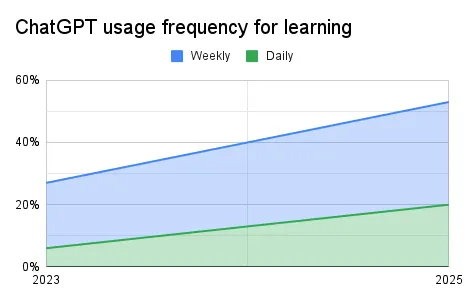
Combined weekly and daily usage exceeds 50%, so it’s fair to say: the majority of students have already integrated artificial intelligence into their learning. The pace of change is also remarkable: in 2023, this figure was below 30%.
“These numbers show that the new technology is here to stay. We actively use artificial intelligence in learning and acquiring the necessary knowledge ” – said Sigve Næss Røtvold, head of NSO, to Khrono.
What Follows from this?
It depends on what students meant by “using it for learning”. We consider it clear: learning becomes more efficient with the use of artificial intelligence. Students get answers faster, structure study material more simply, and access more content in less time. There is no doubt that this optimizes the learning process in terms of time, energy, and cognitive effort.
How might students have actually used artificial intelligence? Based on GoSchool usage data:
- For deeper understanding of the material: if a concept or theory was unclear, AI could help re-interpret it, illustrate it with examples, and formulate it in a way that was more understandable for the student.
- For exploration: if someone was more deeply interested in a topic, AI provided an opportunity to explore related questions, seek new connections, even bridging into other fields of study.
- For debating opinions: if the student wanted not just to learn something, but to think critically about it, AI could act as a partner – helping to formulate their own viewpoint, test counterarguments, and practice argumentation strategies.
- Or simply to automate the writing of assignments: if the goal was merely completion, AI could perform the tasks of text creation, editing, or even source imitation – without any real learning taking place.
And the Teachers?
The article does not mention teacher AI use, and I will not examine it in detail now – but not because it is insignificant. On the contrary: educators’ relationship with artificial intelligence plays a key role in whether education will be able to respond to the emergence of a fundamentally new cognitive possibility.
Generative AI is not simply a new technological tool, but a radically more efficient way to access information, support understanding, and personalize learning.
The question is whether the education system is capable of consciously integrating this – by reinforcing and supporting constructive use – and thereby keeping pace with the changing world, or rather trying to maintain previous modes of operation, even by formally restricting AI use. The decision is not just a technological or institutional matter. It is already a pedagogical, and even strategic, question: will education align with the changing learning culture – or try to defend against it?
GoSchool is not just an educational platform, but also a structured research space where it becomes observable how learning is transforming in the presence of AI. If you’re interested in what AI can actually do – and what students learn from it – check it out.